A small price with a long journey
A shopper picks up two bottles because the shelf label says the second one is half price. At the till, both scan at full price. The queue grows. The cashier checks the label, calls a supervisor, and keys something in to keep the line moving. The shopper leaves slightly annoyed. The store leaves slightly poorer. And nobody can say afterwards exactly why it happened.
I have watched some version of this scene in many stores, and I have sat in the head-office meetings where the same failure shows up later as a number: promotion uplift that never arrived, a spike in manual price overrides, a vendor asking about funding for a deal the shelf never honoured. Promotions are where a retailer’s commercial intent meets physical reality, and the meeting is often clumsy.
This essay walks through what has to go right for a promoted price to reach the shelf and the till, where it quietly breaks, and how to design promotion execution that a store team can actually run.
The journey of one promotion
Plan and fund
A promotion starts as a commercial decision: which item, how deep, which dates, which stores, and who pays. Sometimes the funding is the retailer’s own margin. Sometimes a vendor funds it as part of a wider deal. Either way, the offer is born as a line in a plan, and every later argument about what the offer was supposed to be traces back to how precisely that line was written down. “Two for a fiver on the cola” is not a specification. Which pack, which flavours, does the multi-buy mix across the range, what happens when it meets another live offer: these questions have answers, and somebody has to write them down.
The price file and the rules
Next, the offer becomes data. Head-office systems hold effective-dated price records: the base price, the promotional price, the mechanic (a simple markdown, a multi-buy, a bundle, a member price), the eligibility (which stores, which channels, which customer groups) and the stacking rules (what happens when two offers touch the same basket). This is where ambiguity quietly enters. Two buyers load overlapping offers on adjacent dates. A member price and a promotion both apply to the same item, and nobody owns the question of which one wins. The data is not wrong, exactly. It is undecided.
Distribution to stores
The price file then travels to every store and every channel on a schedule. Mostly this works. But a store that was offline overnight, mid-refit, or simply missed in a range table receives yesterday’s prices. The system of record says the offer is live everywhere. One store’s till disagrees, and that store has no way to know it is the exception.
The shelf edge
In the store, somebody prints the labels and hangs them. This is a physical step: labels printed in batches, walked to the aisle, swapped by hand, removed by hand days later. The shelf edge is the promise the shopper actually sees. It is also the step with the least system control. No scanner checks that the label on the rail matches the price in the file. A label hung early, hung late, hung on the wrong product, or left up after the offer ends is indistinguishable, from the system’s point of view, from a label hung correctly.
The till
Finally, the basket is priced. The till applies the same rules, supposedly: detecting the multi-buy, applying the member price, resolving the coupon, rounding the total. This is where the promise is tested in public, in front of a queue, by a cashier who had no part in any of the earlier steps. When the label and the beep disagree, the cashier absorbs the failure of five upstream handoffs in about ten seconds.
And the mechanics themselves are harder than they look. A mix-and-match across a category has to decide which item is the free one. A member price has to decide whether it stacks with the promotion or replaces it. A coupon has to decide whether it applies before or after the multi-buy. Each of these is a policy decision with margin attached, and in many organisations the honest answer is that the till vendor’s default made the decision years ago and nobody has revisited it since.
Every step has a different owner. The commercial team owns the deal. Pricing owns the file. IT owns the distribution. The store owns the shelf. The cashier owns the moment of truth. Most failures live in the handoffs, not inside any one team, which is why they are so hard to see from anywhere inside the organisation.
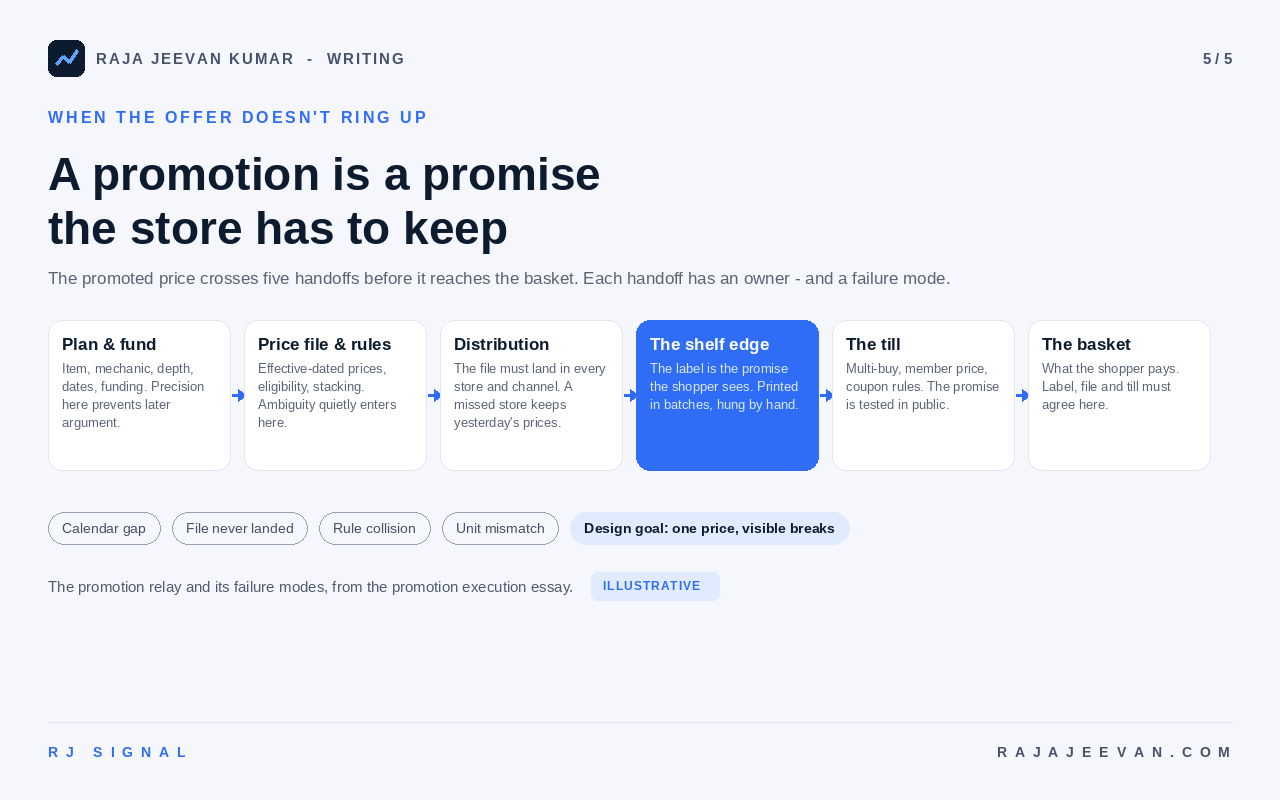
Where it breaks
None of these failures is exotic. Each one is ordinary, known, and tolerated, usually because it is small in the moment and invisible in the aggregate. Together they decide whether a promotion is an event the shopper can trust or a gamble the store is running on its own credibility.
The calendar gap
The label and the price change on different clocks. A label hung before the price is live means shoppers are charged less than they expected, and sometimes the offer is claimed at a depth the plan never approved. A label left up after the price ends is worse: shoppers are charged more than the shelf says. In many markets that is not just a broken promise, it is a pricing-compliance problem with a regulator’s name attached. The gap is usually measured in hours and days, and it is almost always invisible to head office until someone complains.
The file that never landed
The promotion exists in the head-office dashboard and nowhere else. The store never received the file, or received it and failed to apply it, and kept selling at the old price. This failure is discovered weeks later, if at all, when the uplift report disappoints and someone goes digging. By then the vendor is asking what happened to their funding, and the honest answer is embarrassing: the offer ran in the plan, not in the store.
The rule collision
Two promotions touch the same item and the outcome depends on load order or till configuration. One store gives the shopper the better deal, another gives the worse one, a third gives both. The customer’s receipt depends on their postcode. Worse, the collision is usually discovered by shoppers, not by systems, because the systems each did exactly what they were told.
The unit mismatch
The offer was loaded for the 500 ml bottle. The shelf holds the 1 litre. Or the label sits under a lookalike SKU, or an old barcode maps to a new pack size after a range change. The shopper does not care about master data. They care that the label and the beep disagree, and they are right to.
The channel fork
The same offer is supposed to exist online, in the app, for click and collect, and at the shelf. Each channel has its own price feed, its own cache, and sometimes its own promotion engine. The app shows the offer, the store does not. The website honours the multi-buy, the click-and-collect order picks items that no longer qualify. The shopper experiences one retailer; the architecture is running four, and they reconcile, if at all, in the customer’s complaints.
The quiet override
Faced with an unhappy shopper and a growing queue, the cashier keys a manual discount. Humanly, this is completely understandable. Systematically, it is corrosive. The failure disappears from the data, so the root cause survives. Margin leaks one keystroke at a time. And the override report, if anyone reads it, becomes a map of problems nobody is fixing.
Design so the break is visible and small
Promotions will never execute perfectly; too many handoffs involve physical objects and busy people. The goal is different: make failure visible quickly, and make recovery cheap. This is a design problem, not a diligence problem. Telling store teams to be more careful has never fixed a handoff.
One promotion engine. The rules that price the basket should be the same rules that generate the label. When the shelf edge and the till are both rendered from one effective-dated record, the calendar gap shrinks from a data problem to a physical one. Someone still has to hang the label, but at least the label, once hung, says what the till will charge.
Effective dates everywhere, and overlaps on purpose. Every price has a start and an end. Overlapping offers on one item should be a deliberate, reviewed decision with a named owner, never an accident of load order. A simple pre-load report, items with more than one live offer, turns most collisions into a five-minute decision instead of a store-level surprise.
A receipt for the price file. Stores should confirm they applied the file the way tills confirm transactions. A store that has not applied today’s prices by mid-morning is an exception someone sees that day, not a mystery someone investigates next month. This one habit converts the silent failure into a queue of work with an owner.
Make overrides loud. Manual price changes should stay easy for the cashier, because the queue is real, and become impossible to hide: reason codes, daily counts by store and by item, and a standing habit of asking why the top three happened. The goal is not to blame the cashier. The goal is to stop making the cashier the integration layer for broken upstream data.
Walk the promotion. The cheapest audit in retail: on the morning an offer starts, pick ten promoted items, walk the aisle, and compare three numbers that should agree, the label, the file and the till. Twenty minutes. It catches the calendar gap, the file that never landed and the unit mismatch in one pass, on the day they are cheapest to fix. And when a number disagrees, the finding should travel back upstream the same day, to whoever owns the handoff it came from, rather than dying as a corrected label and a shrug.
What a store team can actually run
A checklist that survives a busy Tuesday:
- Write the offer down precisely. Item, mechanic, depth, dates, stores, funding, and what happens when it collides with another offer.
- Check overlaps before load. One report of items with more than one live offer, and a named decision for each.
- Confirm the file landed. Every store, every channel, on activation morning, with a list of exceptions and an owner for each.
- Test three baskets. The promoted item alone, in its multi-buy, and alongside a member price or coupon, before the doors open.
- Walk ten items. Shelf label versus till, on the first morning of the offer.
- Read the override report weekly. Counts, reasons, and the three items that explain most of the volume.
- Close the loop. Every repeated failure gets a cause removed, not another reminder to be careful.
Closing thought
A promotion is a promise the store has to keep on behalf of everyone who made it: the merchant who planned it, the vendor who funded it, the pricing team that loaded it. The shopper only ever meets that promise twice, at the shelf edge and at the beep. When the two agree, nobody notices, and the offer does its quiet work. When they disagree, the queue notices, the cashier pays first, and the brand pays after.
If you run promotions, pricing or store operations and want a second pair of eyes on how your offers travel from plan to basket, I am happy to talk it through. The first conversation is a free 20-minute call: https://topmate.io/raja_jeevan_kumar_maduri