The demo is flawless. The agent reads the request, checks stock, finds the order, drafts the answer and updates the system, all in eleven seconds, in front of an impressed steering group. Two weeks after go-live, a customer writes in about a return that spans two orders and a split shipment, the agent improvises, and the improvisation is wrong in a way nobody catches for three days. The post-mortem finds no bug. The agent did exactly what it was asked to do. The work was never named precisely enough for it to know when to stop.
I have sat through versions of this meeting from both sides of the table, and the pattern is remarkably stable: the teams that struggle with agentic AI are rarely the ones with weak models. They are the ones who started with the agent and worked backwards to the work. The teams that succeed start with the work and treat the agent as a candidate for a job that is already well specified.
This essay walks through the four things that have to be named before an agent touches a workflow, where the quiet failures live, and how to run a pilot that produces evidence instead of theatre.
The work before the agent
Name the decision
Every useful agentic workflow contains a decision that is currently made by a person, slowly, expensively, or inconsistently. Approve the refund within these limits. Reorder this item when the signal fires. Route this exception to that owner. If the team cannot point at the decision and describe what good looks like, the agent inherits the vagueness, and vagueness at machine speed becomes expensive confusion. “Improve customer service” is not a decision. “Resolve a where-is-my-order enquiry by checking the carrier feed and answering or escalating” is.
Name the source of truth
An agent is only as good as the records it reads. Which system holds the real order status: the OMS, the carrier feed, the store’s local log? When they disagree, which one wins? In most organisations this question has an answer that lives in the heads of three senior people and nowhere else. An agent does not have the luxury of that folklore. It will read whatever it can reach, confidently, and the reachable record is not always the true one. Before the pilot, write down the source of truth for every fact the agent will touch, and decide what it should do when two sources disagree. “Escalate” is a fine answer. “Guess” is the default if you do not choose. This mapping exercise routinely surfaces a surprise: a fact the whole workflow depends on that is not reliably recorded anywhere, only reconstructed by experienced staff. That discovery alone is worth the exercise, agent or no agent.
Name the human owner
When the agent acts, who owns the outcome? Not the vendor, not the model, not the team that ran the pilot: the accountable person whose name is attached to the decision being made. A refund approved by an agent is still a refund approved by the business. If nobody will put their name on the decision class, the workflow is not ready for an agent, and it is worth asking whether it is ready at all. Ownership is what turns an agent’s mistake into a fixable incident rather than an orphan nobody claims. It also has a quieter benefit: a named owner asks the uncomfortable pre-launch questions, because it is their name on the hook. Who tested the ambiguous cases? What happens at month-end when volumes triple? Which customers get a human regardless? These questions get asked late or never when ownership is diffuse.
Name the failure path
Agents fail in ways software rarely does: fluently, plausibly, and sometimes silently. Traditional systems fail loudly, with an error code and a stack trace. An agent can fail while producing a beautifully formatted, perfectly courteous answer that happens to be wrong. The failure path has to be designed before the success path is celebrated. What does the agent do when the source of truth is unreachable, the request is ambiguous, the policy does not cover the case, or its own confidence is low? A well-run agentic workflow has an explicit stop: a defined set of conditions under which the agent hands the work back to a human, with its workings attached. The most useful decision an agent can make is often to stop, and that has to be a designed behaviour, not a hoped-for one.
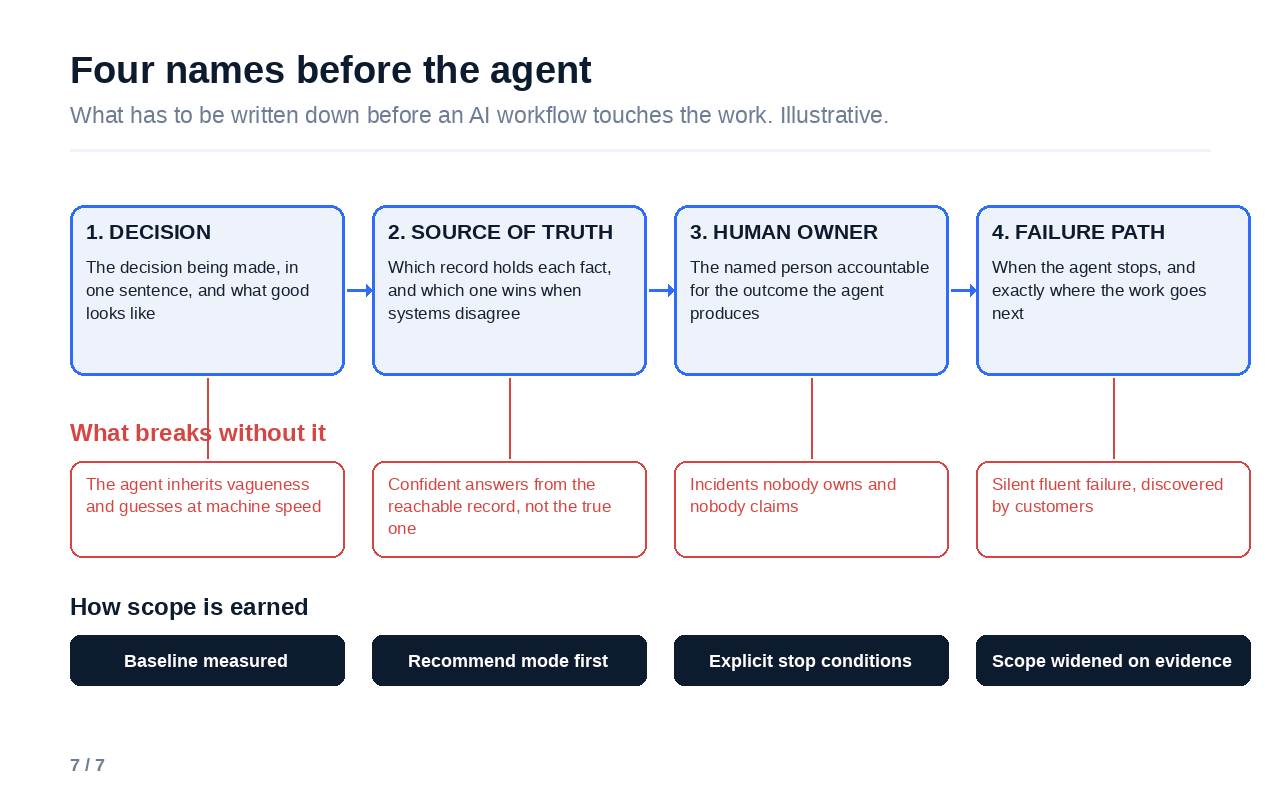
Where it breaks
None of these failures requires a bad model. Each one is an organisational gap that the agent exposes at scale, usually politely, in a tone of complete confidence.
The demo that never met an exception
Pilots are built on happy paths because happy paths are legible. Production traffic is mostly happy path too, until it is not, and the two percent that is not is where the cost and the customers’ patience live. A pilot evaluated on fifty clean cases tells you the agent can do the work on a good day. It says nothing about the day the carrier feed is down and the queue is full.
The unowned handoff
The agent drafts, the human approves, the system executes. In theory a clean chain. In practice the approval becomes a rubber stamp inside a month, because the queue is long and the agent is usually right, and now the human step is theatre: it carries the accountability and none of the scrutiny. If the design depends on a human catching agent errors at volume, measure whether they actually do, not whether the process diagram says they should.
The baseline nobody measured
Ask a team six months into an agentic rollout whether it is working, and the honest ones will say they cannot tell, because nobody measured the before. Resolution time, escalation rate, rework, customer effort: the workflow’s performance under humans is the only honest benchmark. Without it, every claim about the agent is marketing, including the internal kind. The baseline also protects the agent itself: without a before picture, the first bad week becomes the agent’s fault by default, whether or not it caused it.
The confident wrong answer at scale
A person making a mistake makes it once, visibly, and usually within earshot of a colleague. An agent makes the same mistake a thousand times before lunch, in perfect prose. The errors that matter are rarely dramatic; they are small, plausible and repeated: a return policy applied to the wrong category, a delivery promise quoted from a deprecated page. Scale is the point of the technology and also its sharpest edge.
The shadow correction
Faced with an agent that almost works, staff quietly fix its output before it ships. Humanly, this is completely understandable. Systematically, it is corrosive: the correction is invisible in the data, so the gap between the agent and the work survives, and the team that could close it never sees it. The correction log, if anyone keeps one, is the honest map of what the agent cannot yet do.
The pilot that never graduates
The pilot runs for months. It is always nearly ready. The data is almost clean enough, the edge cases are almost mapped, the team is almost confident. Sometimes this is diligence. More often it is a sign that the four names were never written down, so readiness has no definition and the pilot has no exit. A pilot without explicit graduation criteria is not a pilot. It is a demo with a budget.
Design so the agent earns trust
Agentic workflows will never run perfectly; the work itself is too full of exceptions. The goal is different: make the agent’s limits explicit, its failures visible, and its scope earned. This is a design problem, not a model-selection problem.
Baseline first, agent second. Measure the workflow as it runs today: volume, handle time, escalation rate, error rate, and the shape of the exceptions. This is the number every later claim will be judged against, and collecting it costs a few weeks of observation, not a transformation programme.
Start in recommend mode. The agent drafts, retrieves and proposes; the human acts. This is not a timid half-measure, it is instrumentation: every override the human makes is a labelled example of where the agent is wrong, and the override rate is the clearest readiness signal you will get. When the overrides shrink to a stable, explainable residue, the agent has earned the next increment of scope. If they never shrink, that is an answer too, and a cheaper one than finding out in production.
Make stopping a first-class behaviour. Define the stop conditions in the workflow itself: ambiguity, disagreement between sources, policy gaps, low confidence, repeat contact from the same customer. Log every stop with its reason. A rising stop rate is not a failure metric, it is the system working, and a falling one is evidence for widening scope.
Keep the workings. Every agent action should carry its audit trail: what it read, what it decided, what it did, and why, in a form a human can review in seconds. When something goes wrong, and something will, the difference between a one-day fix and a three-day mystery is whether the reasoning was recorded or only the result.
Widen scope on evidence, not enthusiasm. Each expansion, from drafting to acting, from one queue to many, from low to high value decisions, should be gated on the same small set of numbers: override rate, stop rate, exception outcomes, and the baseline comparison. Enthusiasm is a fine reason to pilot. It is a terrible reason to expand.
None of the four names requires new technology. They require a room, a whiteboard and the willingness to write things down that currently live in folklore. Teams that skip this step do not save the time. They borrow it, and the interest arrives as incidents.
What a team can actually run
A checklist that survives a steering committee:
- Name the decision. One sentence, observable outcome, and what good looks like.
- Map the facts. Every fact the agent reads, its source of truth, and the rule for when sources disagree.
- Assign the owner. A named person accountable for the decision class, who has agreed to it.
- Write the stop conditions. Ambiguity, source disagreement, policy gaps, low confidence, and where the work goes when the agent stops.
- Measure the baseline. Volume, time, escalations, errors, before anything changes.
- Pilot in recommend mode. Log every override and every stop, with reasons.
- Review weekly. Override rate, stop rate, and the three exceptions that explain most of the volume.
- Expand on evidence. New scope only when the numbers support it, and never past a named failure path.
Closing thought
An agent is a new colleague with unlimited stamina, perfect recall of whatever it was shown, and no idea what it does not know. The organisations that get value from it are not the ones with the best model. They are the ones that did the unglamorous work first: named the decision, agreed the source of truth, put a person’s name on the outcome, and designed the failure path before the success demo. Start with the work. The agent will still be there when the work is ready for it, and it will be a better colleague for the introduction being an honest one.
If you are weighing an agentic workflow against a real operation and want a second pair of eyes on whether the work is named well enough, I am happy to talk it through. The first conversation is a free 20-minute call: book a call.