Case study | Retail technology | Unattended retail | Problem, opportunity and reference design
Key findings
- Unattended retail only pays when it removes cost the store actually carries, such as labour hours and shrink. Convenience alone does not fund it.
- The format is a spectrum. A smart cooler, a micro-market and a full walk-out store share a core problem, which is knowing exactly what left the building and charging for it correctly.
- Public experience shows the technology can work and still not fit every format. One large operator removed walk-out technology from its larger grocery stores while keeping it in smaller formats.
- Pilots succeed or fail on dispute handling, restocking discipline and item-master accuracy, not on the camera alone.
- The business case should be built on a store’s own loss, labour and traffic baseline, with explicit gates for expansion.
About this study
The author contributed domain expertise to solutions of this kind at a medium-scale, product-based company based out of Dallas and Coimbatore. This study is a reference design. It describes the problem, the opportunity and a solution approach, using public sources. It reports no results from any deployment.
The problem: staffed hours and shrink in small formats
Small-format stores, offices, campuses, hospitals and travel sites share an economic problem. Demand is real but thin, and opening hours are long. A staffed checkout needs a person for every hour that the door is open, even when few customers arrive. At the same time the retail industry is fighting loss: the National Retail Federation’s 2023 security survey put average shrink at 1.6 percent of sales for fiscal 2022, up from 1.4 percent a year earlier.1 An unattended format has to deal with both pressures at once. It cuts the labour that a person at the counter represents, and it removes the cashier’s visibility of the sale, which can raise exposure to loss if nothing replaces it.
Self-checkout shows the shape of that trade. A global survey by ECR Retail Loss reports that retailers estimated self-checkout accounts for as much as 23 percent of their total unknown store losses, with malicious losses forming a large part.2 It is a survey of estimates, not a measured rate, but it tells a designer where the risk concentrates: at the moment of purchase when no one is watching.
The opportunity: let sensors replace the till, not the control
Autonomous checkout uses cameras and sometimes shelf, weight or door sensors to determine what a shopper took, then charges them. The format can be as small as a cooler with a door that unlocks after the shopper taps a card, and as large as a store where shoppers walk in, pick up goods and leave. The same logic applies at every scale: identify the person, track what they pick and return, assemble a basket, charge for it.
The opportunity is clearest where three conditions meet. The assortment is compact, so recognition is tractable. Opening hours are long relative to traffic, so staffing is expensive per sale. And the site has a controlled entry, so identity and exit are well defined. Coolers, micro-markets in workplaces, campus shops and transit sites fit that pattern more easily than a large supermarket with thousands of items, carts and crowds.
What public experience says
The public record is mixed, and a designer should read it honestly. In April 2024 the Associated Press reported that Amazon was removing its Just Walk Out technology from its Amazon Fresh grocery stores in the United States, replacing it with smart carts. The company said it would keep the technology in Amazon Go stores, some smaller Fresh stores in the United Kingdom, and offer it to third-party retailers.3 The reasoning given publicly was about customer preference for seeing receipts and savings while shopping. The report does not give figures on cost or accuracy, and this study does not infer any.
The lesson is about fit. The same technology can suit a compact format and not a large grocery format where shoppers want a running total and where baskets are bigger. Any design should state which formats it is for.
A reference architecture
Figure 2 shows an illustrative architecture in five layers. It applies to a cooler or a store, with different sizes at each layer.
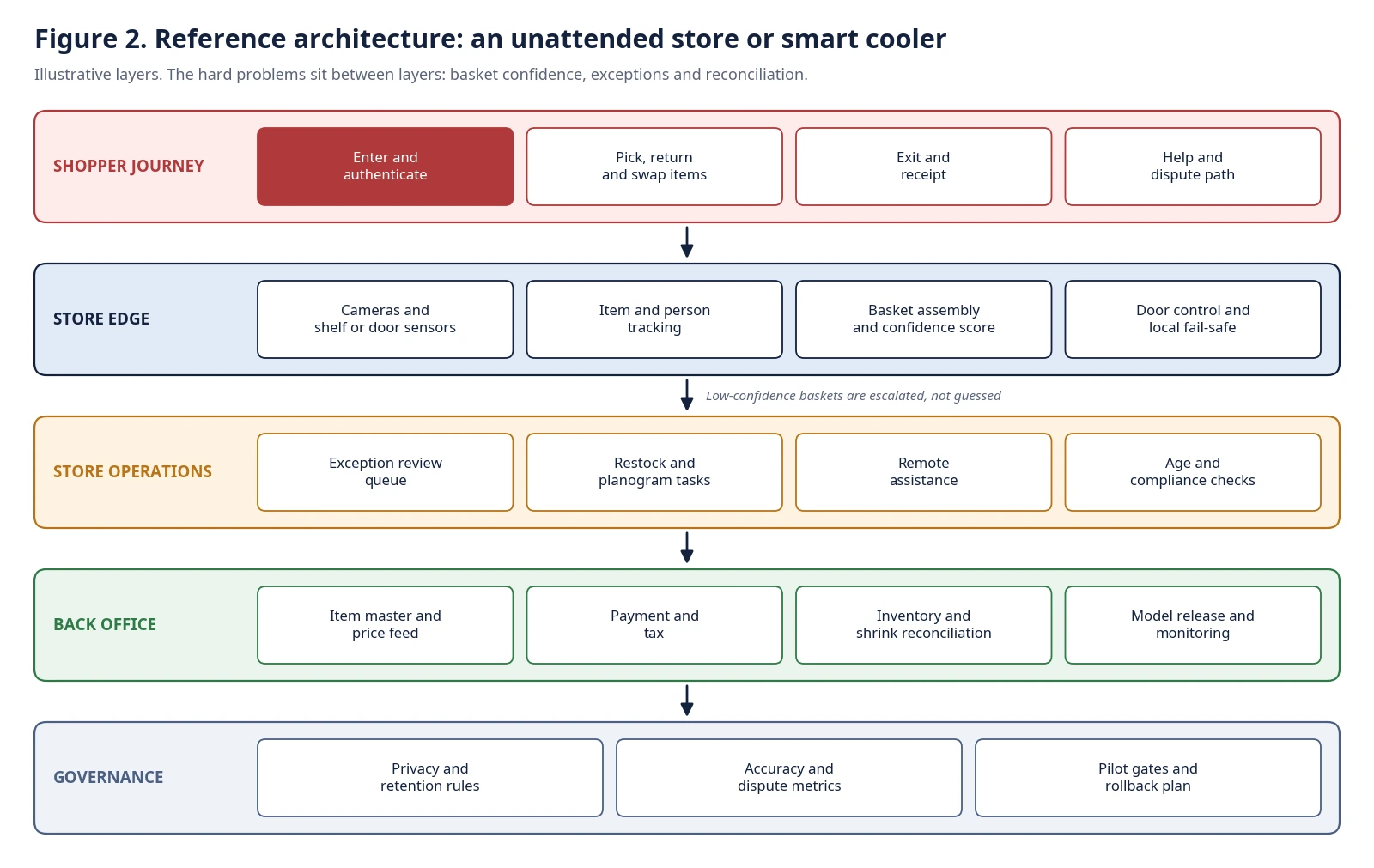
Shopper journey. The shopper enters, authenticates, picks, returns and swaps items, exits and receives a receipt. A help and dispute path is part of the journey from day one, because every autonomous format produces disputes.
Store edge. Cameras and sensors feed tracking and basket assembly on site, with a confidence score for each basket. Door control and a local fail-safe keep the store operating if the network drops. The edge decides quickly and locally. It does not depend on the cloud to open a door.
Store operations. Low-confidence baskets go to an exception review queue. Restocking and planogram tasks come from the inventory the system implies. Remote assistance covers help requests. Age and compliance checks, such as for restricted products, need their own controlled path.
Back office. The item master and price feed are the source of truth for what an item is and what it costs. Payment, tax and inventory reconciliation close the loop. Model releases and monitoring sit here too.
Governance. Privacy and retention rules say what is captured and for how long. Accuracy and dispute metrics are agreed with the business. Pilot gates and a rollback plan define when to expand and when to stop.
Where pilots succeed or fail
Four areas decide the outcome more than the sensing technology.
Restocking discipline. Autonomous systems infer what shoppers took from what was on the shelf. If staff restock out of order, move products or change packaging without updating the catalogue, errors rise. The operating routine for restocking is part of the system.
Item master accuracy. Prices, barcodes, sizes and images all need to be current, and new products need to be enrolled before they reach shelves. A late item is an exception waiting to happen.
Dispute handling. Shoppers will sometimes be charged for something they did not take, or not charged for something they did. A fast, generous and well-documented dispute path protects trust. It also produces labelled data that improves the model.
Shrink design. Autonomous formats replace the cashier’s eyes with sensors, so loss controls need to be designed in: door logic, weight checks on shelves, and clear signage about monitoring. Loss data should be reconciled against inventory counts, not trusted from the system’s own basket totals.
A way to build the business case
A business case for unattended retail should start from the site, not from the technology. For a candidate site, collect the baseline: opening hours, staffed hours, transactions per hour, average basket, shrink and wastage. Then model the format change in three buckets: labour hours removed or redeployed, shrink exposure changed, and sales effect from longer or more convenient access. Each bucket needs a range, not a point estimate, and the ranges should come from the retailer’s own data and a pilot, not from a vendor’s marketing material.
Costs belong in the case as well: hardware and installation, connectivity, remote support, payments, model operations and the staff time that disputes and restocking still need. A format that removes a cashier but adds a roaming support team may not save anything. The gating question for expansion is simple: did the pilot site beat its own baseline on the measures that carried the business case, with disputes and exceptions inside agreed limits?
What this reference design does not show
It does not show that any unattended format reached a given sales uplift, labour saving or loss rate. Vendor websites in this field often show uplift charts. Those are marketing claims, and this study does not rely on them. The sources used here are an industry survey of retailers’ estimates, an industry loss survey and a news report on one operator’s format decisions.
Lessons for leaders
Pick formats where the economics fit. Compact assortments, long hours and controlled entry are the favourable case.
Decide locally. Edge decisions and a fail-safe keep the store working when the network does not.
Run restocking and catalogue upkeep as part of the product.
Make disputes fast and fair. They protect trust and produce training data.
Gate expansion on a site’s own baseline.
Recommendations
Choose two or three candidate sites, ideally in different settings such as a workplace and a transit location. Capture a clean baseline for at least a month. Define the gates and the rollback plan before installation. Run the pilot with a named owner for restocking and a named owner for disputes. Review the first month of exceptions in detail before deciding on a second site.
Teams that want to pressure-test an unattended-retail business case against their own sites can book a working session with the author through Topmate: https://topmate.io/raja_jeevan_kumar_maduri
Sources and method
The author’s domain background informed the framing. Evidence is from the public sources below. Figure 2 was drawn by the author and is a reference design.
National Retail Federation, “National Retail Security Survey 2023”: https://nrf.com/research/national-retail-security-survey-2023↩︎
ECR Retail Loss, “Global Study on Self checkout loss in Retail” (2022): https://ecrloss.com/research-paper/self-checkout-retail-loss-global-study/↩︎
Associated Press, “Amazon is removing Just Walk Out technology from its Fresh grocery stores in the US” (April 2024): https://apnews.com/article/amazon-fresh-just-walk-out-bb36bb24803bd56747c6f99814224265↩︎
Related reading: Why the stock count never matches: a field guide to reconciliation loops.