Current-state snapshot: 5 October 2026
The latest overview describes 22 specialist profiles across analysis and quality, engineering and operations, and strategy and communication. It reports a model-routing gateway with fallbacks, three-tier memory, semantic indexing, shared task state, 27 MCP servers and a shared skills library of 440+ skills (subtotals inconsistent, so no total is claimed). These are self-reported claims, not independently verified. No throughput, reliability, cost or security result is claimed. Local addresses, ports and paths are omitted.
An AI assistant can respond well and still be expensive to operate. It can repeat instructions, load context that the task does not need, use visual automation where a structured interface would suffice, and report completion before anyone has checked the result. Adding more agents does not automatically fix those problems. It can spread them across more processes.
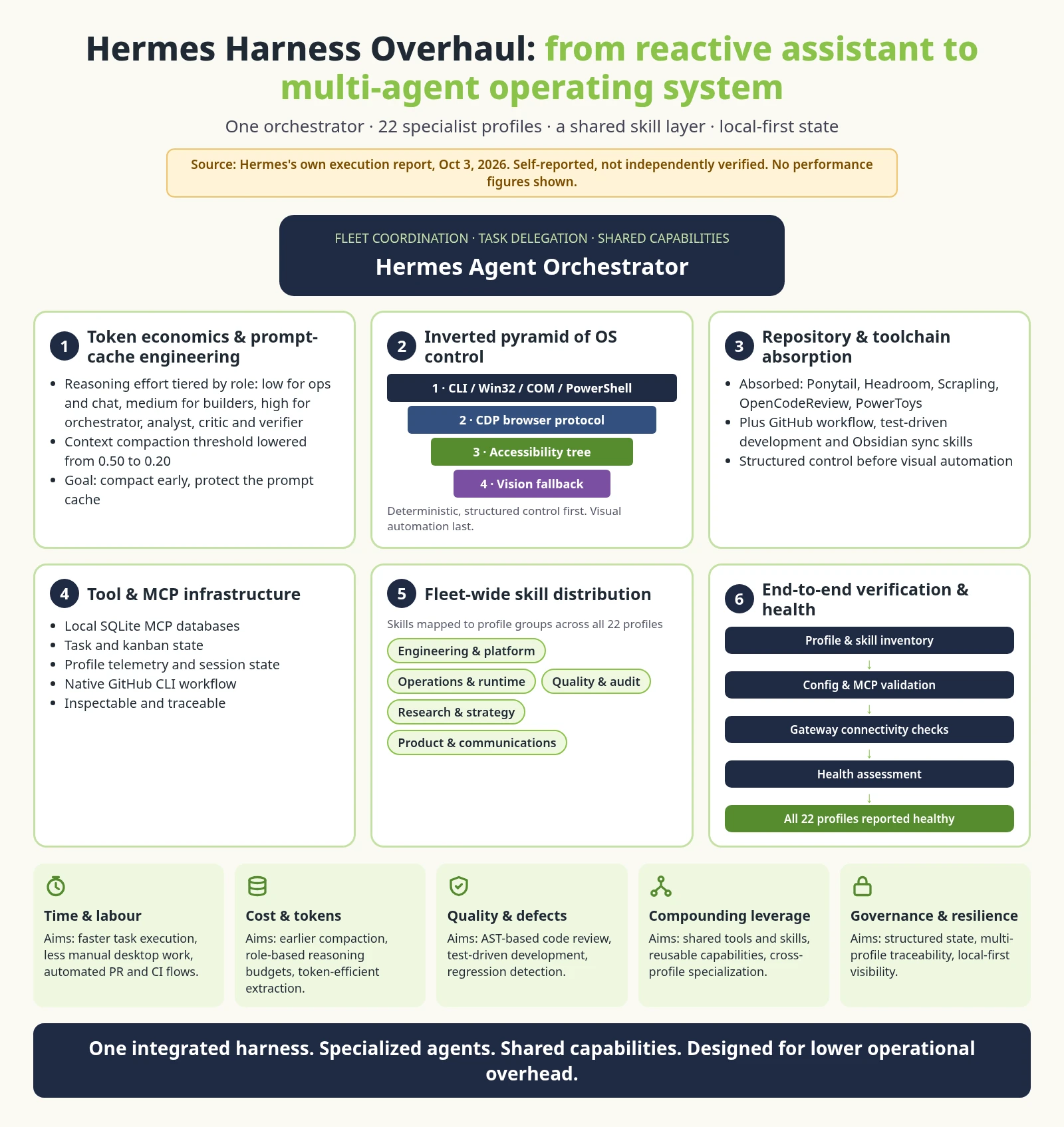
Hermes's execution report describes a different direction: a central orchestrator, specialist profile groups, shared capabilities, structured execution paths, local task state, and an explicit verification loop. The experiment is about the operating system around the model. Its central question is whether a more disciplined harness can reduce operational overhead without lowering the quality of the work.
This article explains the architecture, the changes reported by Hermes and the questions needed to evaluate them. Raja supplied Hermes's executive execution report as additional context. Its implementation and health statements are self-reported, not an independently audited result. The report does not supply reproducible test logs or a controlled comparison method. Its performance estimates are not presented here as demonstrated savings.
What is reported, and what is established
The available inventory check found profile folders matching the fleet described in the report. Folder existence does not establish that every profile is running, correctly configured or effective. Hermes separately reports completing the architectural changes and finding the profiles healthy. Those are execution-report claims pending inspection of the underlying configuration and diagnostic output.
The distinction is important. This is now more than an unsupported picture of an idea: there is a supplied execution narrative describing the work. But a narrative with a DONE label is not the same as a reproducible evidence bundle. The article therefore attributes changes to Hermes, explains why they might matter, and leaves their measured effect open.
The problem: capability without coordination
A multi-agent setup creates several kinds of overhead. Each agent needs enough context to understand the job. It may need tools, a working directory, task history and a way to leave evidence. When those concerns are repeated inside every profile, small inefficiencies accumulate. A large prompt becomes a recurring expense. A loosely defined task becomes several competing interpretations. A missing handoff becomes another round of explanation.
The diagram proposes grouping responsibilities rather than treating every profile as an interchangeable assistant. Engineering and platform work sit together. Operations and runtime work form another group. Quality and audit are distinct from research and strategy. Hermes occupies the coordinating position between them.
The useful design question is not how many profiles exist. It is whether the division changes the work. A specialist profile should receive a clear responsibility, the relevant capabilities and a definition of an acceptable result. Otherwise, specialization is only a label attached to the same general-purpose behavior.
For a reader considering a similar experiment, this is the first test: does adding a profile reduce uncertainty about ownership, or merely add another place where a task can get lost?
One coordinator, several specialist roles
At the center of the source diagram is the Hermes Agent Orchestrator. The diagram names fleet coordination, task delegation and shared capabilities as its responsibilities. Around it are the profile groups that contribute different kinds of work, including product and communications alongside the other specialist groups.
This separation makes coordination an explicit concern. A research profile can gather material. An engineering profile can turn an agreed requirement into an artifact. A quality profile can examine that artifact against the requirement. The orchestrator should retain the connection between the original goal and the final result.
That sequence is an interpretation of how the architecture could be used, not a claim that every path has been implemented or tested. Its value is that it gives the experiment a coherent unit of evaluation: a task with an owner, a sequence of contributions and a checked output.
Hermes's public documentation describes profiles as independent agent environments with separate configuration, memory, sessions, skills and gateway state. That supports the general idea of role separation. It does not establish this particular fleet's installation or permissions. Profiles also should not be confused with a security sandbox. An agent's access depends on its execution environment and tool permissions, not simply on the existence of a separate profile.
Shared skills, selective context
The diagram places shared runtime skills beneath the orchestrator and distributes them across appropriate profile groups. This is a different proposition from placing every instruction into every request.
A skill can preserve a repeatable method: how to review a repository, prepare a document, extract relevant material or check an output. But a skill is useful only when its contents are appropriate for the task and its assumptions remain current. A large collection of methods can become another source of unnecessary context if everything is loaded at once.
Hermes's skills documentation describes progressive disclosure: making skills discoverable without loading their full contents into every conversation. That is a relevant mechanism for the design's context-efficiency goal. It does not prove that any particular distribution strategy produces the reductions shown in the supplied image.
The tradeoff is between shared learning and uncontrolled propagation. A useful correction should reach the profiles that need it. A flawed instruction should not spread simply because it sits in a common library. Versioning, review and a way to withdraw a broken skill therefore belong in the evaluation, even though the diagram does not establish how those controls are implemented.
Token economics: measure the right categories
Hermes reports combining telemetry analysis, tiered reasoning, earlier context compaction and prompt-cache optimization. These are related concerns, but they are not the same measurement. According to the report, routine operations, communication and synthesis received lower reasoning effort; building, platform and security work received medium effort; orchestration, analysis, compliance, criticism, research, evaluation, strategy and verification received higher effort. This is a reported configuration choice, not proof that the allocation is optimal.
Reasoning budgets concern how much computation a task receives. Context compaction concerns what conversation state is retained. Prompt caching concerns the reuse of eligible prompt material. A shorter response does not by itself establish a cheaper task. A cache hit does not establish a correct answer. A compacted conversation can save context while losing a requirement that later forces the work to be repeated.
Public provider documentation explains reuse of prompt prefixes and distinguishes cache creation from cache reads. That distinction matters when interpreting telemetry. A report should identify what its token categories mean, which provider produced them and which requests are included.
For this experiment, the defensible objective is to reduce unnecessary work while preserving task quality. The evaluation needs completed tasks, failures, retries and human correction time alongside token counts. A configuration that consumes fewer tokens but needs more repair is not automatically more efficient.
Hermes also reports moving context compaction earlier. The specific threshold and the telemetry behind it have not been independently checked. No cache or reasoning savings are calculated here. A defensible result would require accounting definitions and a reporting window.
Structured execution before visual automation
One of the clearest design choices is the inverted pyramid of operating-system control. The diagram prefers command-line and native interfaces first, browser structure next, accessibility interfaces after that, and vision-based interaction as a fallback.
The reasoning is practical. A structured interface can identify an operation and return a result without asking a model to infer every step from pixels. A browser or desktop accessibility interface can expose names, roles and control behavior. Vision remains valuable when the interface offers no dependable structured route.
Public Windows accessibility documentation describes programmatic access to interface elements. Browser-automation documentation describes interaction through structured accessibility snapshots. Those sources support the availability of these approaches, not a universal performance ranking across all applications.
The hierarchy should therefore be understood as a preference, not an absolute law. A native command may expose a dangerous operation. An accessibility tree may be incomplete. A screenshot may reveal a dialog or layout problem that a structured read misses. The quality of the evidence matters more than loyalty to a particular control method.
A good experiment compares methods on the same tasks and checks the final state. It should count recovery effort and incorrect actions, rather than recording only the quickest successful run.
Repository understanding without carrying the whole repository
The repository and toolchain pillar proposes a compact capability map per group. The broad idea is to avoid making every profile reconstruct the whole environment before it can do useful work.
A capability map can describe what a component is for, where it fits in a workflow and what evidence it can return. That can make routing more deliberate. It also creates a maintenance obligation: a map that describes yesterday's installation can send today's task to the wrong tool or an unavailable dependency.
Hermes reports absorbing repository and workflow capabilities for minimalist implementation, context retrieval, web extraction, AST-based code review, desktop automation and knowledge synchronization. These tool-specific integration claims remain self-reported. The report describes one retrieval plugin as staged, so absorption should not be confused with every component being fully active. This article does not claim that a review tool caught a particular defect or that a scraping integration authorizes bypassing a site's access controls.
The transferable lesson is narrower. Repository context should be scoped to the decision being made. A reviewer needs the changed behavior, the relevant surrounding code and the checks that support the result. Supplying more text is not a substitute for supplying the right evidence.
Local-first state is a coordination choice
Hermes reports a local SQLite database cluster for task and Kanban state, profile telemetry and session state, and decision records and traces. The supplied report is the source of this implementation claim; the underlying database setup has not been independently inspected. It presents local-first structured state as a foundation for automation and traceability.
The attraction is understandable: explicit records can preserve task status outside a conversation. A task should not disappear because a session ends. A tool result should be connected to the work that produced it. A later reviewer should be able to distinguish an attempted action from a verified outcome.
A local state store does not automatically solve ownership, consistency or recovery. The design must still define which component writes which record and what happens when a write fails.
Local-first also does not mean secure by default. Permissions, backups, secret handling and retention need their own controls. The architecture image is not sufficient evidence of those controls, so no security certification or assurance is claimed here.
MCP connects capabilities, not trust
The tool infrastructure uses MCP as a way to expose capabilities to the agent environment. That can make integrations easier to discover and use. It does not make every connected tool or every piece of returned content trustworthy.
The MCP project's security guidance discusses authorization boundaries and risks such as confused-deputy behavior. For a harness experiment, the practical implication is to distinguish access from permission. A tool may make an action possible while the action still requires human authorization.
This matters especially when one specialist produces material that another specialist consumes. The receiving profile needs to know whether it is looking at task data, a proposed instruction or evidence of approval. A message that sounds confident should not silently acquire authority as it moves through the system.
This is an evaluation principle, not a claim that the depicted installation already enforces every boundary. The experiment should demonstrate the boundary on a real task and preserve enough evidence for someone else to inspect it.
Verification belongs in the main workflow
The final operational pillar shows an inventory, configuration and MCP validation, gateway connectivity checks, a diagnostic step and a health assessment before production readiness. That is a useful ordering: readiness should follow checks rather than replace them.
Still, health and task success are different states. A reachable gateway does not prove a document is accurate. An installed tool does not prove a browser action selected the correct item. A diagnostic that returns no errors does not establish that a multi-step task met its acceptance criteria.
Hermes reports running an ad-hoc validation and a diagnostic health check across the fleet. The actual diagnostic output was not included with the briefing. That reported health snapshot therefore cannot establish current readiness or become an ongoing assurance.
A stronger completion record would connect the task, the artifact, the acceptance criteria and the verification result. For visual work, that includes inspecting the rendered output. For a structured data change, it includes reading back the stored state. For research, it includes sources that actually support the claims. These are proposed standards for evaluating the design, not reported test results.
How to evaluate the experiment without overstating it
The supplied executive report contains a transformation scorecard, but its performance reductions and response-time figures are estimates without a reproducible test log. The review illustration leaves them out. A clean before-and-after comparison would require a measurement method and an accompanying evidence record.
A useful evaluation would start with a small, fixed task set. Examples might include a repository change, a research brief and a desktop workflow. These are illustrative test categories, not claims about runs already completed. Each task would have a defined expected result and a baseline execution path.
The comparison would record the active configuration, model and provider, task difficulty, relevant cache state, retries, elapsed time, token categories and human intervention. It would also record failed runs rather than showing only the successful examples. Results would be compared within equivalent tasks, with the method explained alongside the outcome.
The intended benefits remain hypotheses, not achieved results. Until evidence is available, the honest conclusion is that the architecture suggests several routes to lower overhead. Their magnitude remains an open experimental question.
What this design gets right, and what it still has to prove
The strongest idea is the connection between specialization, structured execution and verification. These are often discussed separately. Here they are placed inside the same operating model: route the work, load the relevant capability, choose a suitable execution method, preserve state and check the result.
The unresolved issue is whether those pieces work together consistently. Shared capabilities can reduce duplication or distribute mistakes. Earlier compaction can remove clutter or discard a requirement. Structured interfaces can make execution clearer or increase the reach of a wrong action. Local state can preserve continuity or preserve an incorrect status.
That is why the next meaningful artifact is not a larger architecture image. It is a reproducible task trace with an output that survives review. The experiment should be judged by the work it can finish correctly, not by the number of profiles in its header.
For teams exploring similar systems, the opportunity is to design the operating discipline around the model before expanding the fleet. The question worth asking is simple: where does the work become cheaper, clearer and easier to verify, and what evidence would convince someone other than its builder?
If your team is testing an agentic workflow, I can help frame that evaluation: the task boundaries, the evidence required and the tradeoffs that matter before a wider rollout. The architecture is the starting point. The checked result is what earns confidence.
Sources and evidence boundaries
The primary sources are Raja Jeevan Kumar Maduri's supplied architecture diagram and Hermes's executive execution briefing, shared by Raja in the same conversation. The briefing supports attribution of reported changes to Hermes, not independently verified deployment or performance. The published-facing illustration removes private endpoints, uncertain tool identities and unsupported performance figures.
The following public documentation supports the technical context. It does not validate the installation or implementation or performance claims:
- Hermes Agent: profiles. Independent profile configuration and state; distinction between profiles and sandboxing.
- Hermes Agent: skills. Reusable methods and progressive disclosure.
- Anthropic: prompt caching. Prefix reuse and separate cache accounting categories.
- Microsoft: UI Automation overview. Programmatic access to Windows UI elements and control patterns.
- Playwright MCP. Browser interaction using structured accessibility snapshots.
- Model Context Protocol: security best practices. Authorization boundaries and security risks in connected tool workflows.