A shopper opens the app at the till to pay with her points. The app shows 4,200 points and a free delivery voucher. The till shows nothing: no balance, no voucher, no record that she exists. The cashier shrugs politely. She pays full price, the queue moves on, and somewhere upstream a chain of systems quietly files the moment under “no error reported”.
I have watched versions of this scene across loyalty programs and delivery promises, and I have sat in the meetings afterwards where it shows up as a number: redemption rates that never climbed, a surge of “where are my points?” contacts, a marketing team wondering why the members it recruited do not come back. Loyalty is where a retailer’s promise meets its plumbing, and the meeting is often clumsy.
This essay walks through what has to go right for an earned point to become a reward the customer can actually use, where the chain quietly breaks, and how to design loyalty handoffs that a team can actually run.
The journey of one point
The earn
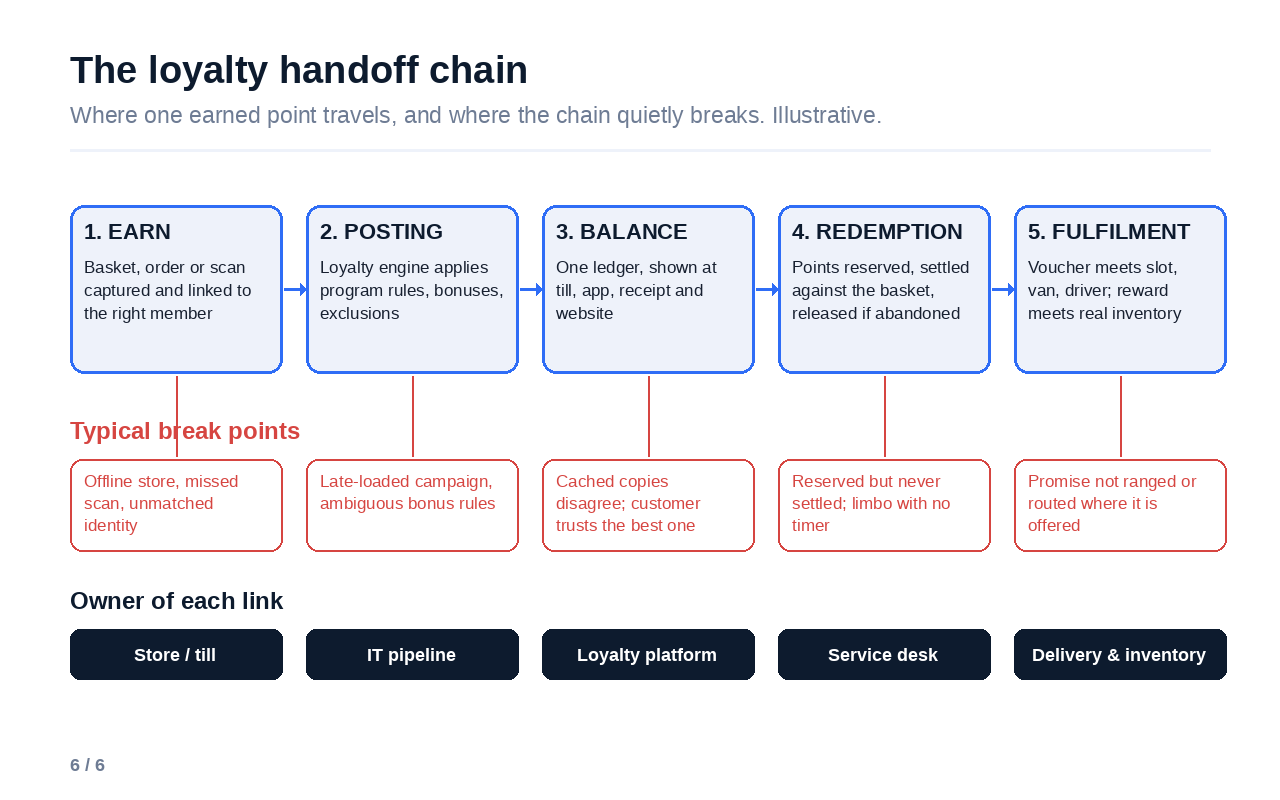
A point starts as an event: a basket at a till, an order on the website, a scan of a member card in a queue. The event has to be captured, linked to the right member, and sent onwards. That sounds trivial and is not. The customer forgot to scan and the cashier adds it afterwards. The store was offline and the event sits in a local queue. The app order used an email that differs from the one on the loyalty account by a single character. Every one of these is a fork where the earn can silently detach from the person who earned it.
The posting
The event travels to the loyalty engine, which applies the program rules: base points, multipliers, bonus campaigns, exclusions. Effective dates matter here as much as they do in pricing. A double-points weekend that the engine loads late, or a bonus category that excludes a product the campaign page includes, produces a balance that disagrees with what the customer was told to expect. The earn happened. The posting is where it is interpreted, and interpretation is where ambiguity lives.
The balance
The posted points land in a wallet the customer can see: a number in an app, on a receipt, at the till. This balance is the program’s public face. It is also frequently a copy: the app reads a cached figure, the till reads another feed, the website a third. When the copies disagree, the customer believes the one that is best for them and feels cheated by the one at the till. They are right to. The program made the promise; the copies just delivered it badly.
The redemption
Spending points is a transaction with its own handoffs: reserve the points, confirm the discount or voucher, settle it against the basket, and release the reservation if the basket is abandoned. A redemption that reserves but never settles leaves points in limbo: gone from the customer’s view, nowhere in the store’s accounts. A basket abandoned at the payment step can hold points hostage for hours or days unless someone designed the release.
The fulfilment
The reward is not real until it is delivered, literally. A free-delivery voucher has to meet a delivery system with a slot, a van and a driver. A reward item has to exist in inventory at the store or warehouse that will honour it. This is the handoff loyalty programs design least and customers feel most: the moment a promised reward meets physical operations. A voucher for a product the local store does not stock is not a reward. It is an argument waiting to happen.
Every step has a different owner. Marketing owns the program design. IT owns the event pipeline. The loyalty platform owns the ledger. The store owns the moment of truth. Delivery owns the last mile. Most failures live in the handoffs, not inside any one team, which is exactly why they are so hard to see from anywhere inside the organisation.
Where it breaks
None of these failures is exotic. Each one is ordinary, known, and tolerated, usually because it is small in the moment and invisible in the aggregate. Together they decide whether a loyalty program is a reason to return or a reason to distrust.
The earn that never arrived
The basket happened, the points did not. The store was offline, the card was added after the fact, the event was dropped by a queue nobody monitors. The customer notices at the balance, days later, and the trail is cold. The system of record shows nothing wrong, because from its point of view nothing was ever sent.
The return that clawed back twice
A returned basket should reverse its points, once. In practice the reversal fires from the till and again from a batch reconciliation, or it reverses points the customer already spent, pushing a balance negative without anyone deciding that should be possible. Returns are the loyalty ledger’s least-loved edge case, and the customer who returns things often learns to distrust the program fastest.
The split identity
One person, two profiles: the email on the app, the phone number at the till, an old account from a migration. Points accumulate in both and are redeemable in neither with confidence. Every merge is a judgment call about which balance is real, and every unmerged duplicate is a customer whose history the program has quietly amputated.
The redemption in limbo
The app says the voucher was used. The basket never completed. The points sit reserved against a ghost transaction, and the release job runs nightly, or weekly, or never. The customer experiences this as theft, and from their side of the screen it is indistinguishable from it.
The promise operations cannot keep
Marketing offers members free next-day delivery. The delivery network in half the regions runs two-day. Or the reward item is ranged in 200 stores and the voucher is valid in 800. Each team did its job correctly. The promise was assembled from parts that were never checked against each other, and the store team discovers this one angry member at a time.
The quiet adjustment
Faced with an unhappy member, a service agent adds the missing points by hand. Humanly, this is completely understandable. Systematically, it is corrosive. The failure disappears from the data, so the root cause survives. The adjustment log, if anyone reads it, is a map of problems nobody is fixing.
Design so the break is visible and small
Loyalty will never execute perfectly; too many handoffs involve busy tills, flaky networks and real people. The goal is different: make failure visible quickly, and make recovery cheap. This is a design problem, not a diligence problem. Telling customers to keep their receipts has never fixed a handoff.
One ledger, many views. The balance should be a single record that every channel reads, not a figure each channel computes. When the app, the till and the receipt render from one ledger, disagreement between them becomes impossible by construction, and the remaining failures move to where they can be found: at the earn and the posting.
Every earn gets a receipt. The till or app should confirm points earned the way it confirms payment: immediately, visibly, with a reference the customer can quote. An earn that cannot be confirmed at the moment of purchase is an exception that day, not a mystery next month. This one habit converts the silent failure into a queue of work with an owner.
Pending is a state, not a bug. Points that have been earned but not yet posted should be visible as pending, with an honest time when they will land. Customers tolerate waiting far better than they tolerate silence. A program that shows its workings earns trust precisely where a hidden one loses it.
Redemptions release by design. Reserved points should expire back to the customer on a timer measured in minutes, with the expiry visible in the app. Limbo should be a state the system refuses to hold, not one it forgets it is holding.
Check the promise against the operation before launch. Every reward and benefit should be walked through the fulfilment chain once, on paper, before it is announced: which stores stock the reward item, which regions honour the delivery promise, what the member sees when neither is true. A one-page handoff map, with a named owner for each link, catches most broken promises while they are still cheap to fix.
Make adjustments loud. Manual point corrections should stay easy for the agent, because the member is standing there, and become impossible to hide: reason codes, weekly counts by cause, and a standing habit of asking why the top three happened. The goal is not to blame the agent. The goal is to stop making the agent the integration layer for broken upstream handoffs.
What a team can actually run
A checklist that survives a busy Tuesday:
- Map the handoffs once. Earn, posting, balance, redemption, fulfilment, with a named owner for each link and the failure mode listed beside it.
- Confirm the earn at the moment of purchase. A visible receipt of points, with exceptions queued same-day.
- Reconcile the ledger daily. Events received versus points posted, and any gap over a small threshold investigated, not archived.
- Test the redemption path weekly. Earn, redeem, abandon, return: the four transactions that break most, run against a test member.
- Walk one promise a month. Pick a live reward or benefit, follow it from the marketing page to the shelf or the doorstep, and write down where the promise and the operation disagree.
- Read the adjustment log weekly. Counts, reasons, and the three causes that explain most of the volume.
- Close the loop. Every repeated failure gets a cause removed, not another reminder to be careful.
Closing thought
A loyalty program is a promise the whole operation has to keep on behalf of the team that designed it: the marketer who wrote the offer, the engineer who piped the events, the store that hosts the moment of truth, the van that carries the reward. The customer only ever meets that promise twice: when the points should appear, and when the reward should arrive. When both happen quietly, nobody notices, and the program does its slow work. When either fails, the customer pays first, the store team pays next, and the brand pays after.
If you run loyalty, delivery or customer operations and want a second pair of eyes on how your promises travel from program design to the member’s hand, I am happy to talk it through. The first conversation is a free 20-minute call: book a call.