Case study | Practical AI | Computer vision data operations | Problem, opportunity and reference design
Key findings
- In retail computer vision, the model is rarely the bottleneck. Getting enough correctly labelled images of the right situations is.
- The catalogue changes constantly, so a labelled set is never finished. Data operations need a standing process, not a one-time project.
- Synthetic images are best used to fill specific gaps, such as rare items, unusual angles and lighting, and are only trustworthy when tested against real held-out data.
- Model-assisted labelling lets people review proposals instead of drawing every box or mask. The review step and the audit of label errors keep quality high.
- Success should be defined by performance on real store data and by the cost and time to add a new item, not by dataset size.
About this study
The author contributed domain expertise to solutions of this kind at a medium-scale, product-based company based out of Dallas and Coimbatore. This study is a reference design. It describes the problem, the opportunity and a solution approach, using public research. It reports no results from any deployment.
The problem: a business case that stalls at the data
Computer vision business cases in retail usually start with a use case that looks clear: recognise products at checkout, count stock on shelves, track pickups in an autonomous store. The model architecture is rarely the part that stalls the project. The part that stalls is the training data.
The authors of the RPC retail checkout dataset describe the difficulty precisely. Automatic checkout has to handle a large number of fine-grained product categories, and it is hard to collect training images that reflect realistic checkout scenes because products are updated continuously.1 Those two facts, many similar-looking classes and a catalogue that never stops changing, define the data problem for any retail vision system.
Annotation cost compounds it. NVIDIA researchers writing about synthetic data observed that training a detector normally needs a large amount of manually annotated data, which is expensive, and that for tasks such as pixel-level segmentation a human can need a substantial amount of time to label a single image.2 In a retail setting each new product, packaging change or camera position can reopen the work.
The opportunity: two tools that reduce the wall
Two techniques address different parts of the problem.
Synthetic data. Rendered or composited images can cover situations that are hard or slow to photograph: a rare item, an unusual orientation, a lighting condition, an occluded item. The research by Tremblay and colleagues showed a useful principle called domain randomization, in which the simulator’s parameters such as lighting, pose and textures are varied in deliberately non-realistic ways so the network learns the essential features of the object. They reported that a network trained on synthetic data alone could reach compelling performance on their task, and that fine-tuning with real data gave better performance than real data alone.3 Note the scope: their evaluation was car detection on a driving benchmark. The principle transfers as a hypothesis to retail, and a retail programme must test it on its own images.
Assisted annotation. A model proposes labels, and people accept or correct them. Meta’s Segment Anything project is a public example of the approach at scale. Its authors built a promptable segmentation model and used it in a data collection loop to create a dataset of more than 1 billion masks on 11 million licensed and privacy-respecting images.4 A retailer will not build a dataset that size. The reusable idea is the loop: use a model to speed up labelling, then use the corrected labels to improve the model.
A reference design
Figure 3 shows a proposed closed loop. It is illustrative, and it is not a description of any particular product.
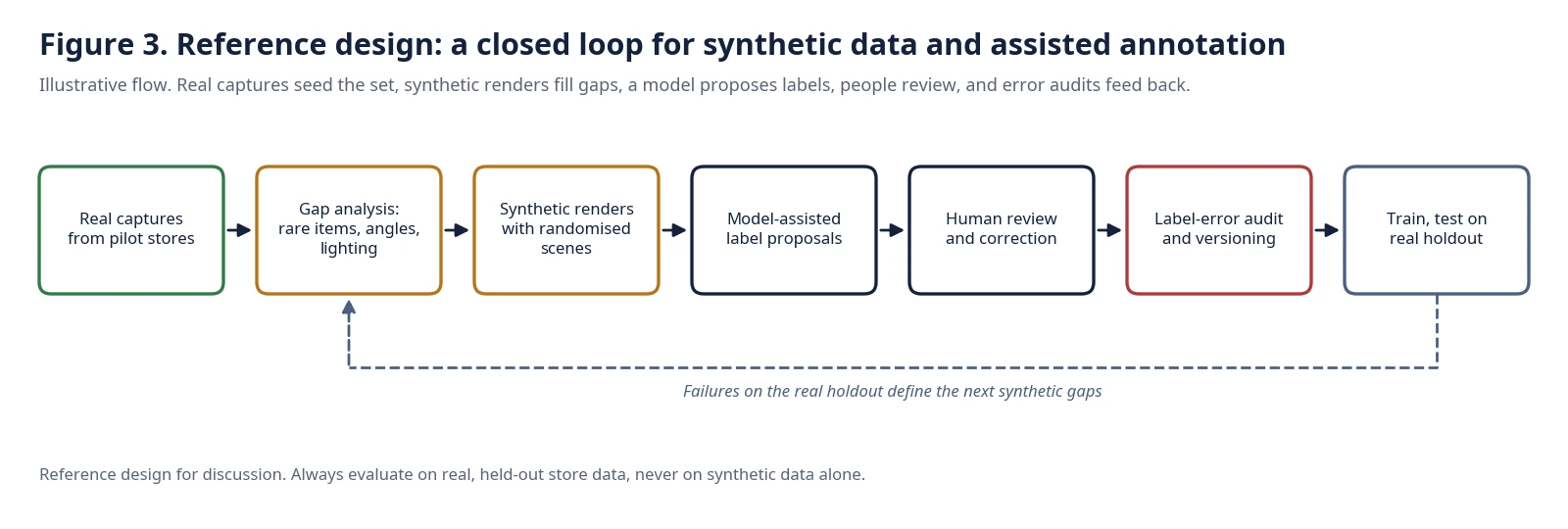
Real captures from pilot stores. The loop starts with real images from the sites where the system will run. These give the real distribution of lighting, tray wear, packaging and shopper behaviour, and they form the real held-out test set. The test set is protected and never used for training.
Gap analysis. The team lists what the model gets wrong or has never seen: rare items, similar-looking pairs, awkward angles, partial occlusion, poor lighting. Each gap becomes a specification for new data. This step stops synthetic generation from becoming an unfocused volume exercise.
Synthetic renders. Using item models or scanned items, the team renders scenes with randomised lighting, backgrounds, poses and stacking. The aim is coverage of the gaps, with enough variation that the model cannot rely on artefacts of the renderer. Because real packaging changes often, a pipeline that can regenerate an item quickly is more useful than a large static library.
Model-assisted label proposals. For real images, a model proposes boxes or masks and item identities. For synthetic images, labels come free from the renderer, but should be spot-checked for errors in the pipeline.
Human review and correction. Reviewers accept, adjust or reject proposals in a fast interface. Their time goes to the hard cases. Review guidelines need to be explicit: what counts as the same product, how to treat damaged packaging, how to label partial items.
Label-error audit and versioning. Mislabelled examples cap accuracy quietly. Confident learning, a method for estimating uncertainty in dataset labels and finding likely label errors, is one way to audit a set systematically.5 Every dataset version should be recorded with what changed and why, so a model can be traced back to its data.
Train and test on the real holdout. The model is trained on the combined set and evaluated only on real, held-out store images. Failures on that holdout feed back into the next gap analysis.
Operating the loop
A loop like this needs owners and a rhythm. A data product owner decides priorities from the exception and error reports. A small labelling team, internal or external, reviews proposals against written guidelines. A model engineer trains and evaluates. A catalogue owner tells the team which items are about to change.
Useful operating measures are about the loop, not about volume. How long does it take to add a new item from first sight to live recognition? What share of reviewed proposals are accepted unchanged? How many label errors does each audit find, and are they falling? How does accuracy on the real holdout change between versions? These are measurable in any pilot and say far more than the number of images.
Risks and how to handle them
Synthetic overfitting. A model can learn the renderer. The control is the real holdout, plus a policy that no release is judged on synthetic data alone.
Reviewer drift. Labelling guidelines are interpreted differently over time. The control is periodic cross-review and the label-error audit.
Bias toward easy cases. Assisted labelling is fastest on easy images, so hard cases can be under-represented. The control is to sample deliberately from the exception queue and from the lowest-confidence predictions.
Privacy. Store images may include people. Camera placement, retention limits and access rules should be set in advance, and datasets shared with outside labelling teams need the same controls. Public datasets such as SA-1B were described as licensed and privacy respecting, which is a useful standard to aim for when sourcing images.6
Cost creep. Without a defined gap list, synthetic generation and review can expand without improving real-world accuracy. The control is to tie every data request to a measured failure.
What this reference design does not show
It does not show that any pipeline cut annotation cost or raised accuracy by a given amount. The research cited here shows that the techniques work in their own settings, on car detection and on general segmentation. It does not prove the effect in a retail checkout. The right way to adopt the design is as a hypothesis, tested with a small experiment on real store images and judged on a real holdout.
Lessons for leaders
Plan for data operations, not a dataset. The catalogue changes, so the process has to keep running.
Use synthetic data for named gaps. Tie each batch to a failure you measured.
Keep the real holdout sacred. It is the only honest test.
Let models propose and people decide. Review time is best spent on hard cases.
Audit labels. Quiet errors set the ceiling on accuracy.
Recommendations
Before scaling a vision programme, set up the loop on one small catalogue. Capture real images from a pilot site, freeze a holdout, and measure the baseline. Generate synthetic data only for the top failure modes. Track time to add a new item as a headline measure. Review the results after one cycle and decide whether to widen the catalogue.
Teams that want to pressure-test a vision data pipeline against their own catalogue can book a working session with the author through Topmate: https://topmate.io/raja_jeevan_kumar_maduri
Sources and method
The author’s domain background informed the framing. Evidence is from the public sources below. Figure 3 was drawn by the author and is a reference design.
Wei et al., “RPC: A Large-Scale Retail Product Checkout Dataset”: https://arxiv.org/abs/1901.07249↩︎
Tremblay et al., “Training Deep Networks with Synthetic Data: Bridging the Reality Gap by Domain Randomization”: https://arxiv.org/abs/1804.06516↩︎
Tremblay et al., “Training Deep Networks with Synthetic Data: Bridging the Reality Gap by Domain Randomization”: https://arxiv.org/abs/1804.06516↩︎
Kirillov et al., “Segment Anything”: https://arxiv.org/abs/2304.02643↩︎
Northcutt, Jiang and Chuang, “Confident Learning: Estimating Uncertainty in Dataset Labels”: https://arxiv.org/abs/1911.00068↩︎
Kirillov et al., “Segment Anything”: https://arxiv.org/abs/2304.02643↩︎