Case study | Retail technology | Computer vision | Problem, opportunity and reference design
Key findings
- Retailers have already scaled self-checkout. The open problem is losses and exceptions at the lane, not whether shoppers will use it.
- A vision-based tray checkout replaces scanning with recognition. That moves risk from the shopper’s hands to the model’s confidence, so the exception path becomes the product.
- A basket should be accepted only when several independent checks agree: recognition, weight, price rules and catalogue. Disagreement goes to a person.
- Every corrected exception is a labelled training example. A design that captures them improves with use. A design that discards them stalls.
- Pilots should be gated on measured recognition accuracy, exception rate and dispute rate in real stores, not on demos.
About this study
The author contributed domain expertise to solutions of this kind at a medium-scale, product-based company based out of Dallas and Coimbatore. This study is a reference design. It describes the problem, the opportunity and a solution approach, and it draws on public research. It reports no results from any deployment, and nothing in it should be read as a claim that a specific product achieved a specific outcome.
The problem: the lane is where retail loses control
Self-checkout is now routine in grocery and common in other formats. A 2022 global survey by ECR Retail Loss of 93 retailers in 25 countries found fixed self-checkout in use at 96 percent of grocery respondents and 77 percent of non-grocery respondents. The same respondents estimated that self-checkout accounted for as much as 23 percent of their total unknown store losses, and two-thirds said the problem was getting worse.1 That is a survey of retailers’ own estimates, so it shows concern and direction, not a measured industry rate. The broader context is that the National Retail Federation’s 2023 security survey put average shrink at 1.6 percent of sales for fiscal 2022, up from 1.4 percent a year earlier.2
The same survey of retailers shows how they respond. Weight controls were the most deployed and most effective intervention on fixed lanes. Interest was growing in analytic controls that spot non-scanning, product recognition mismatches and barcode switching.3 In plain terms, the industry is adding sensing to a process that relied on a shopper doing a manual step correctly.
That is the opportunity for vision. If a camera can identify what is on a tray, the manual step disappears for many items, including produce, bakery and loose goods that have no barcode, and the system gains an independent view of what is actually being bought. Research datasets have existed for years to test exactly this task. The RPC dataset, for example, was built to benchmark automatic checkout from images of retail products. Its authors name the main challenges as the large scale and fine-grained nature of product categories, and the difficulty of collecting training images that reflect realistic checkout scenes while products keep changing.4
Why the screen is not the main problem
Many self-checkout redesigns focus on the interface: larger buttons, clearer prompts, fewer screens. Those matter, but they do not address the failures that cost retailers money and shoppers time. Three failure types dominate any design review.
Recognition errors. Two items look alike, an item is hidden behind another, packaging changes for a season, or lighting shifts. The system either names the wrong product or declines to name one.
Basket mismatches. Recognition says one thing and weight, price or purchase rules say another. For example, a recognised item is a different size from the one the shopper took, or an age-restricted item appears without a check.
Exception handling. When the system is unsure, someone has to resolve it. If that takes an attendant for every unsure basket, the labour saving disappears. If it takes nobody, the loss risk returns.
The design question is therefore not “can the model recognise items?” but “what happens at the edge of its competence, and how fast does it learn from that edge?”
A reference design
Figure 1 shows the proposed flow. It is illustrative, and it is not a description of any particular product.
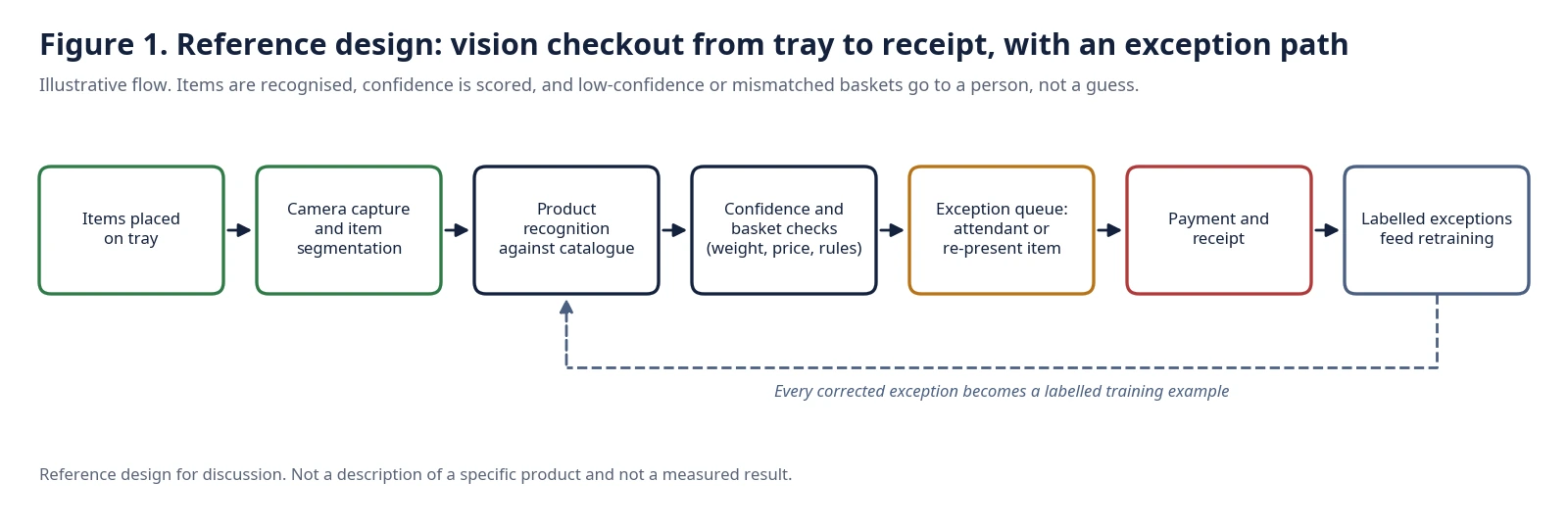
Capture and segmentation. Fixed cameras above a tray capture the items. Segmentation separates items from each other and from the tray. This step decides whether touching or stacked items can be handled at all, so the physical design of the tray and the camera angle belong in the specification, not only the model.
Recognition against a catalogue. Each segment is matched against the retailer’s item master. The catalogue is the source of truth. A model that recognises products the catalogue does not hold, or the reverse, creates exceptions that no accuracy figure will reveal. Keeping the item master current and mapped to image classes is a continuous operating task.
Confidence and basket checks. Recognition is one signal. The design combines it with weight, price and rule checks, and with the count of segmented items. The system accepts a basket only when the signals agree within set tolerances. Retailers’ own survey results point the same way: weight controls were rated most effective on fixed lanes, so a vision design should add to them, not replace them.5
Exception queue. When signals disagree or confidence is low, the shopper is asked to re-present an item, or an attendant is called through a queue that shows the tray image and the system’s best guesses. The attendant resolves it in seconds with a tap. The shopper never sees an accusation. The wording of prompts is part of the design, because a wrong accusation costs more trust than a missed item.
Payment and receipt. Once the basket is accepted, payment and receipt follow the retailer’s normal rules.
Feedback. Every exception that a person resolves is stored with its image and its correct label. This is the cheapest source of hard examples the programme will ever get. It feeds retraining, and it feeds a weekly review of which items and which lanes generate the most exceptions.
Data and model choices
The recognition model needs images of every catalogue item in realistic conditions. For a grocery or convenience catalogue that means thousands of items, constant churn, and long-tail products that appear rarely. Three practices matter more than the choice of network.
First, capture in the stores where the system will run. Lighting, trays, bags and shopper behaviour differ between sites, and a model trained on one site’s images degrades at another.
Second, treat new items as a workflow. A product enters the catalogue, a capture session collects images, the model is updated and tested, and the item goes live. The time between a product arriving and the system recognising it is a metric in its own right.
Third, audit the labels. Mislabelled training images quietly cap accuracy. Techniques such as confident learning exist to find likely label errors in a dataset, and they are worth running on any set built at scale.6
Operating model and governance
A vision checkout also changes the operating model. Store staff move from scanning disputes to exception resolution, which needs new training and a fast interface. Loss prevention teams need a view of exception patterns, not only receipts. Privacy needs an explicit answer: what is captured, whether faces are excluded by camera placement, how long images are kept, and who can see them. Regulators’ guidance on video processing, such as the European Data Protection Board’s guidelines on video devices, is a useful baseline for that conversation in any market that follows it.7
Pilots should have gates. A reference set of gates: a minimum recognition accuracy on a held-out set of real baskets, a maximum exception rate per hundred baskets, a maximum dispute rate, and a rollback plan that returns a lane to conventional scanning. The thresholds are for the retailer and the vendor to agree before the pilot. This study sets none, because setting them without data from a specific store would be inventing results.
What this reference design does not show
It does not show that any system reached a given accuracy, saved a given amount of labour or cut losses by a given share. The retailer survey figures describe concern about self-checkout losses in general, not the effect of vision. A reader should treat the design as a checklist of questions to put to any vendor or internal team: how is confidence defined, what happens below it, how fast do exceptions become training data, and how are new items added.
Lessons for leaders
Design the exception path first. The share of baskets that reach a person, and how long they wait, decides the business case.
Combine signals. Recognition, weight, price and rules should agree before a basket is accepted.
Treat the item master as part of the model. Recognition accuracy cannot exceed the quality of the catalogue it matches against.
Capture exceptions as data. The system should improve every week because people use it.
Gate pilots on real-store measures. Demos are not evidence.
Recommendations
For a retailer considering vision-based checkout, start with a loss and exception baseline on the current lanes. Choose one format and a small catalogue for a pilot. Agree the gates before installation. Run the exception queue with real staff from the first day. Review exception patterns weekly and publish the results internally.
Teams that want to pressure-test a checkout design against their own catalogue and lane layout can book a working session with the author through Topmate: https://topmate.io/raja_jeevan_kumar_maduri
Sources and method
The author’s domain background informed the framing. Evidence is from the public sources below. The design is a reference design, and Figure 1 was drawn by the author.
ECR Retail Loss, “Global Study on Self checkout loss in Retail” (2022): https://ecrloss.com/research-paper/self-checkout-retail-loss-global-study/↩︎
National Retail Federation, “National Retail Security Survey 2023”: https://nrf.com/research/national-retail-security-survey-2023↩︎
ECR Retail Loss, “Global Study on Self checkout loss in Retail” (2022): https://ecrloss.com/research-paper/self-checkout-retail-loss-global-study/↩︎
Wei et al., “RPC: A Large-Scale Retail Product Checkout Dataset”: https://arxiv.org/abs/1901.07249↩︎
ECR Retail Loss, “Global Study on Self checkout loss in Retail” (2022): https://ecrloss.com/research-paper/self-checkout-retail-loss-global-study/↩︎
Northcutt, Jiang and Chuang, “Confident Learning: Estimating Uncertainty in Dataset Labels”: https://arxiv.org/abs/1911.00068↩︎
European Data Protection Board, “Guidelines 3/2019 on processing of personal data through video devices”: https://www.edpb.europa.eu/our-work-tools/our-documents/guidelines/guidelines-32019-processing-personal-data-through-video_en↩︎
Related reading: When the till disagrees: POS exception handling a store team can run and Between scan and settlement: the checkout plumbing nobody sees.