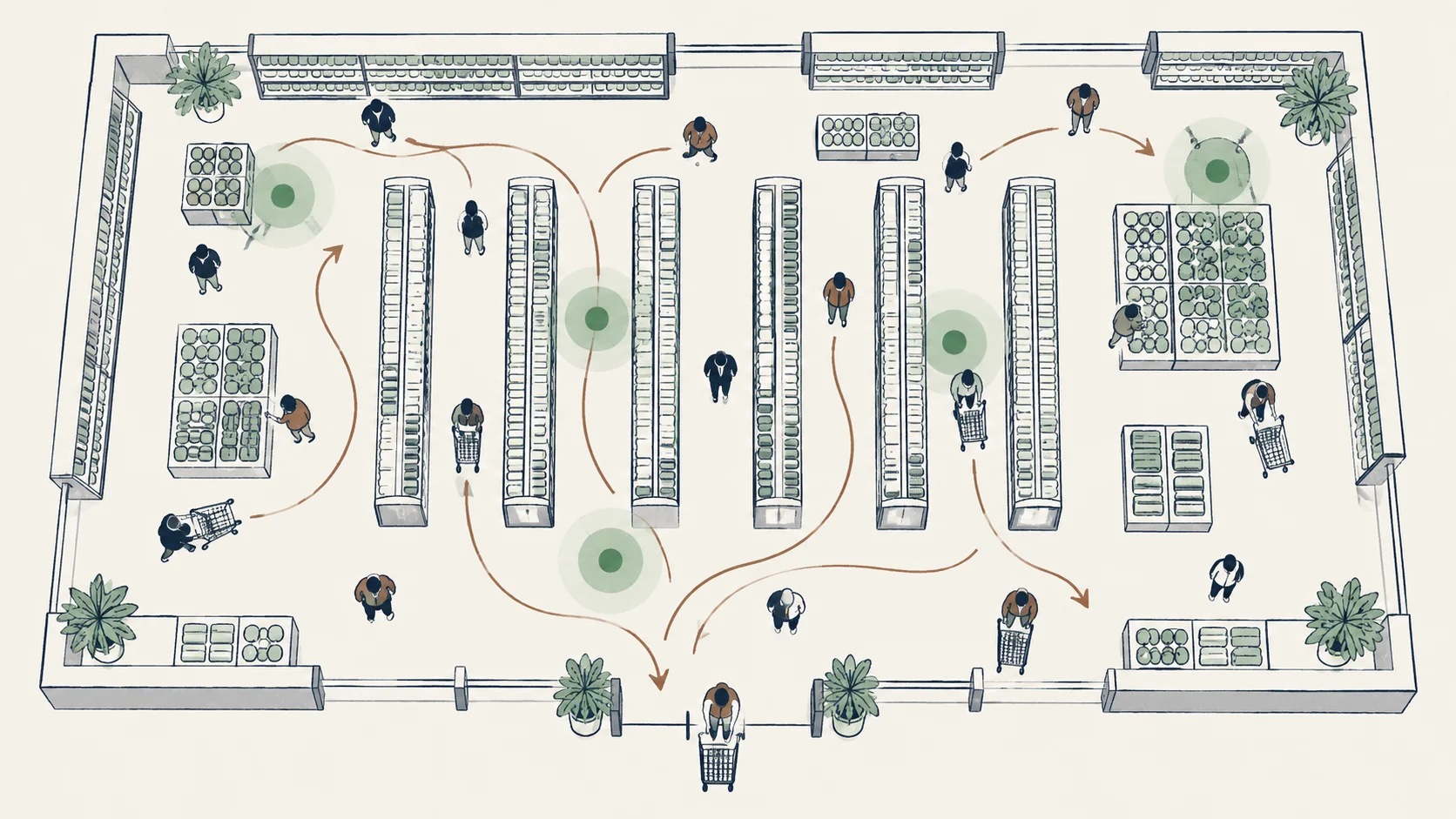
A store has two records of its day. Transaction systems describe purchases, returns, prices and stock movements. Cameras capture activity in physical space. Neither record is a complete account of why the day unfolded as it did. A busy aisle may produce few sales. A promotion may draw attention while the product is unavailable. The design opportunity sits between those records, but joining them does not automatically explain them.
I designed a video-intelligence concept to explore that connection. The source work covers candidate use cases, store and headquarters data, integration questions and the responsibilities needed to make an analysis useful. This is solution design, not a production deployment. The scenarios below explain how I would reason about the design; they do not describe measured results from a client installation or promise that a particular model can deliver them.
The central idea is a layer that turns selected physical observations into defined operating signals, adds the context needed to interpret them, and delivers them to a person who can act. The camera is an input, not the product. The product is a useful decision loop. My design questions focus on how that loop should behave when its evidence is good, uncertain, missing or no longer relevant.
Keep the sources of truth separate
The layer should sit alongside the systems responsible for transactions, inventory, workforce planning and business intelligence. A camera observation does not become the authority for a price or stock balance. It contributes a different kind of evidence. Keeping that boundary clear prevents an analytics service from becoming an accidental second source of truth for information owned elsewhere in the retail environment.
An illustrative merchandising review might combine aggregate movement near a display with category sales and a record of availability. Video suggests where attention occurred. Point of sale supplies sales. Inventory supplies availability. The review should expose the origins and limits of these inputs. It should not replace them with a single score whose meaning cannot be traced back to the measures that produced it.
Different uses also need different timing. A retrospective merchandising review can tolerate a delay if it is labelled. A prompt intended to influence checkout conditions needs current evidence and a response route. Treating both as one generic stream invites mistakes. An old event can look like a current problem, while a current signal can disappear inside a report intended for next week's review.
Turn the use-case list into decision contracts
The reference work explores queues, traffic, heatmaps, product interaction, merchandising and operational context. I would organise these as decision contracts rather than a feature catalogue. Each contract names the user, the question, the signal, the supporting context and the response. It should also name the limits: what the observation cannot establish and which judgements the service must not make.
A queue case might ask when a supervisor should inspect checkout conditions. A traffic case might ask whether an aisle layout deserves review. A merchandising case might ask whether a display arrangement merits another trial. These differ in urgency, consequences and evidence needs. They should not inherit the same alert threshold simply because the same underlying video feed contributes to all of them.
I would start with questions that have understandable actions and checkable evidence. Aggregate crowding is a more bounded starting point than a claim about shopper intent. The first version should help an existing role make an existing decision. It should not invent a new judgement about people and then search for a business process willing to accept it without validation.
Preserve the difference between seeing and explaining
A boundary crossing, estimated zone occupancy or period of detected dwell is an observation under a rule. "The display persuaded shoppers" is an interpretation. More time near a shelf could indicate interest, congestion, confusion or a popular route. The camera does not settle those alternatives. Business context and review may narrow them, but the uncertainty should remain visible until the evidence supports a conclusion.
I would therefore prefer labels such as observed movement, estimated traffic and candidate congestion. These labels are less dramatic than behavioural intelligence, but they tell the user what the system actually offers. A dashboard should not increase confidence merely by making a number look polished. It should help the reader understand the measurement, its coverage and the conclusions that can reasonably follow.
This separation helps diagnose mistakes. A wrong report can result from detection failure, a poor definition, stale context or an interpretation that went too far. A single opaque score makes these failures look alike. Showing a small number of understandable components gives the operating team a way to ask the right question instead of arguing about whether the model is generally "good" or "bad."
Define the event before building the dashboard
A useful event needs more than a count and a timestamp. It needs a store, a zone, a period, a measurement definition and a quality state. Those fields allow a later reader to understand what was measured and whether it can be compared with another interval. Without them, a number can travel through several reports while shedding the assumptions that gave it meaning.
Missing and zero must remain different. An unavailable camera should not suggest there were no visitors. A blocked view should not suggest queues improved. A stale event should not look like a live warning. This design choice makes absence explicit. It is better for a service to say it cannot currently measure a condition than to produce a neat value that sends the manager in the wrong direction.
Changes need to remain visible too. If a store moves a display or redraws a zone, the measurement may change before customer behaviour does. The reporting process should let users identify that break. I would treat the definition and its revision history as part of the business reporting contract, not as a hidden technical setting that only an engineer can explain.
Add context only where it earns its place
The source work maps potential video measures against transactions, prices, promotions, inventory and calendar context. I would use that map as a discovery aid, not a demand to connect every system. Each dependency should answer a specific ambiguity. Who owns the input? Is it timely enough? What happens if it is missing? What decision would become less reliable without it?
For a merchandising review, price changes and stock availability may explain differences between periods. For traffic patterns, store hours and events may matter. These proposed relationships can improve the question being asked. They do not prove that a combined dataset can identify the cause of an individual purchase. The design should keep that limit even when a chart places two trends side by side.
Aggregate analysis is the preferred starting point where it answers the operating question. Linking movement to loyalty identity is a separate, more sensitive proposal. It should not happen by default because a technical join appears possible. A data relationship has privacy, access, maintenance and interpretation costs. Those costs belong in the design conversation before the project treats the connection as an obvious next feature.
Design the recipient's experience
An alert demands attention. The recipient should know where the observation occurred, when it was made, whether it persists and what they are being asked to do. A prompt for inspection is different from a confirmed incident. A possible response is different from an authorised instruction. The interface should not give all three the same language or urgency simply because an automated system produced them.
For an illustrative crowding prompt, a supervisor might inspect the checkout zone and record that the situation was real, already handled or not actionable. The record should include room for an explanation. A dismissal may reveal a poor threshold, an unsuitable view or a conflicting priority. It should not automatically become a judgement about the supervisor's performance or willingness to follow technology.
The service also needs a quiet state. Repeating the same unresolved signal every few moments can turn a useful observation into noise. If nobody owns the response during a shift, the system should not pretend the operating loop is complete. The design should make assignment, acknowledgement and suppression understandable, while leaving staffing and other consequential decisions with the authorised store team.
Test the signal and the service separately
The measurement test asks whether the observation is suitable for its intended use. It should examine representative views, changing light, obstruction, crowding and relevant operating periods. It should look at false prompts, missed events and conditions where the system should declare uncertainty. A successful demonstration under favourable conditions does not establish that the measure is ready for every store or every shift.
The service test asks a different set of questions. Did the prompt arrive in time? Could the manager understand and act on it? Was the response useful? Did repeated messages create distraction? A model can perform adequately while the service performs poorly. I would allow that outcome in the evaluation rather than use a detection benchmark to claim an operating benefit the trial did not establish.
Retrospective analytics need their own evaluation. Business users should interpret definitions consistently and understand which comparisons are valid. Samples can be reviewed against agreed observations and known context. The aim is not a ceremonial sign-off on a dashboard. It is to discover whether the reporting process supports the decisions it was designed for and where it still needs correction or restraint.
Treat privacy as a scope filter
The archive contains ambitious ideas involving identity and inferred emotion. I would not present their inclusion in a reference table as proof of reliability, suitability or approval. The first question is whether the operating need can be met without them. Aggregate movement and zone observations may answer a useful question without attaching a name or supposed state of mind to a person.
A trial would still need privacy and security review, including access, retention, notice and permitted uses for footage and derived data. This article does not certify legal compliance. It describes a design preference: decide the purpose and boundaries before expanding collection. The store should not discover after a demonstration that a service intended for queues has grown into an unrelated customer-profiling programme.
I would exclude automated accusations and avoid treating facial expression as a reliable account of emotion or intent. Human review is not a universal safeguard that makes any inference acceptable. The proposed use itself needs examination. Clear exclusions keep a broad opportunity map from being mistaken for a tested capability catalogue, and make the product's limits part of the offer.
Put maintenance next to the architecture
The operating owner of the feed, the measure, the context and the response should be identifiable. A store layout change can affect a zone. A reporting change can affect transaction comparisons. A provider update can affect access. The concept should include a route for these changes to be noticed and reviewed before a once-useful signal becomes an unreliable background service.
The responsibility model also makes the proposal realistic. Store teams define the operational question and response. Technology teams validate access and integration. Analysts examine measures and comparisons. The designer connects those responsibilities and exposes gaps. Nobody can guarantee the whole result merely by supplying one block in the diagram. That is why ownership belongs beside architecture instead of appearing after a pilot has begun.
A use case should be allowed to retire. If it creates more noise than value, the organisation should be able to stop it, preserve what was learned and reconsider its assumptions. A feed should be allowed to report unavailable. A pilot should be allowed to remain a pilot. These are normal outcomes of careful design, not failures to be concealed behind a dashboard that keeps running.
Grow from a working loop
Breadth is useful in discovery. It should not determine the first delivery scope. I would begin with a small set of cases that have clear owners, modest data needs and observable responses. That phase should establish behaviour when evidence is useful, uncertain and absent. Only then should the design add new interpretations, new integrations or more consequential recommendations.
Every extension needs its own review. Does it need a different camera view? Does it introduce new personal data? Does the receiving team have a response process? Does it make a stronger claim than the previous case? Reusing a technical component does not answer these questions. A growing service should carry its evidence and boundaries forward rather than inheriting confidence from an unrelated successful test.
This makes the buying conversation more concrete. The organisation can evaluate dependencies, responsibilities and exclusions instead of purchasing an open-ended promise of insight. The design earns credibility by saying where it cannot answer yet. A possible application, a demonstrated measurement and a maintained operating capability are different stages. My public description of this work should keep them different.
What the work demonstrates
This concept demonstrates how I connect retail questions, physical observations, integration needs and measurement. It shows a way to turn a wide opportunity into a bounded service with responsibilities and exclusions. It does not establish a deployed system, a sales increase or a labour saving. Such claims would need evidence from an implementation, a suitable comparison and an operating review.
The useful unit is the decision loop: observe a defined condition, add justified context, explain what is known, ask the right person to review, and learn whether the response helped. The camera is one input and the model one component. Video intelligence becomes worth testing when the whole loop is clear enough that a store team can use it, question it and stop it when it is not helping.